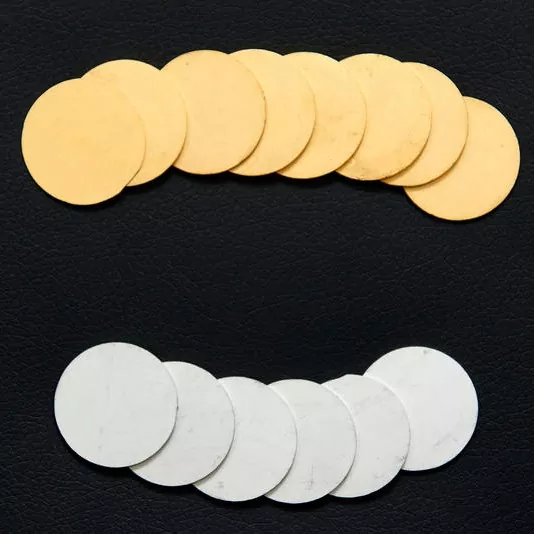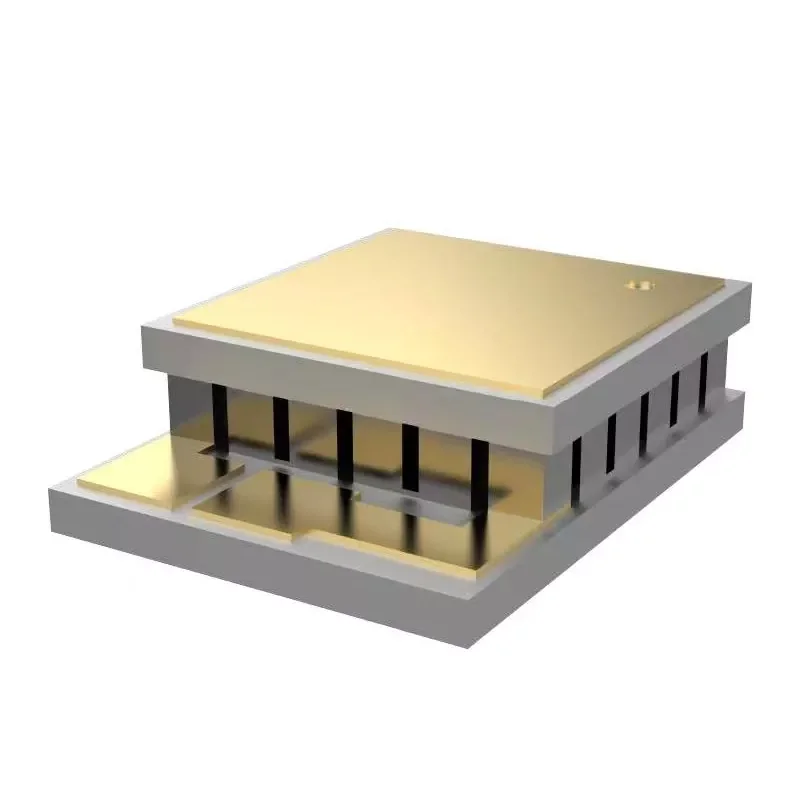
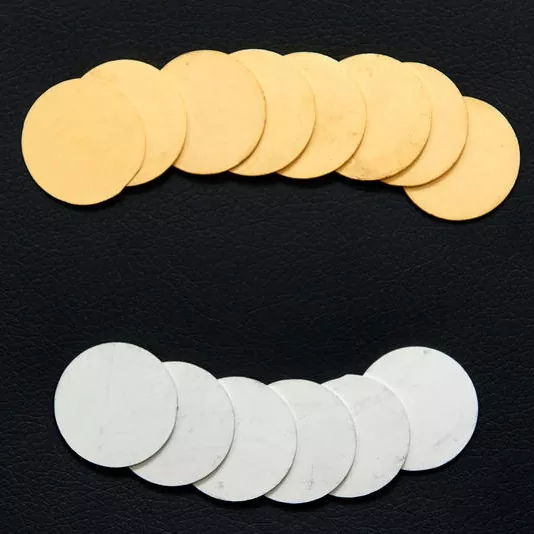
Designed to address interfacial degradation and solder diffusion issues during thermoelectric cooler (TEC) assembly, X-Meritan’s Slices with Diffusion Barriers provide a highly stable, assembly-ready component for advanced thermal management.By introducing a precise nickel-based barrier between the Bi₂Te₃-Sb₂Te₃ substrate and the solderable surface, these slices effectively mitigate elemental migration, stabilizing electrical resistance and mechanical strength through repeated thermal cycles.
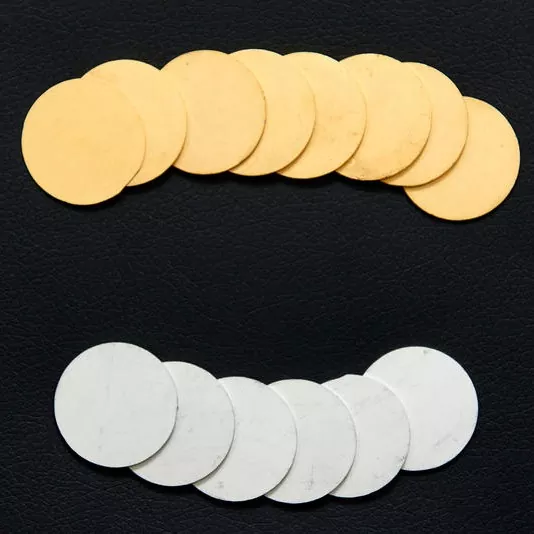
Slices with Diffusion Barriers are pre-processed thermoelectric material slices with a protective metallization structure designed to control interaction between the thermoelectric substrate and the solder used during TEC assembly.
The base material is an extruded Bi₂Te₃-Sb₂Te₃ thermoelectric ingot. After precision processing, a nickel-based diffusion barrier is applied between the thermoelectric material and the external solderable layer. This creates a controlled interface that helps limit unwanted elemental migration and interfacial reactions during soldering and subsequent thermal cycling.
The barrier is particularly important because the thermoelectric material and solder have different chemical and physical properties. During repeated heating and cooling, uncontrolled interaction at the interface can contribute to changes in electrical resistance, mechanical degradation, or deterioration of the solder joint.
The core metallization structure uses a nickel-based diffusion barrier between the Bi₂Te₃-Sb₂Te₃ substrate and the solderable outer layer.
This intermediate layer helps control the movement of solder constituents toward the thermoelectric material and provides a more stable interface for TEC assembly. A multi-layer configuration can be selected according to the intended soldering process and operating environment.
Rather than relying on a single surface coating, X-Meritan can provide multi-layer metallization structures in which different layers perform different functions.
The inner barrier layer focuses on material separation and diffusion control, while the outer solderable layer is selected according to the joining process.
Electroless tin plating is available at approximately 7 ± 2 μm.
The Slices with Diffusion Barriers tin surface provides good solder affinity for conventional soldering processes and can be used with both leaded and lead-free solder systems, depending on the customer's assembly process.
This configuration is generally appropriate when the primary requirement is a practical solderable surface for standard TEC production.
For applications requiring a thin gold finish, X-Meritan offers electroless gold plating with an Au thickness of less than 0.2 μm.
Gold provides a surface with good oxidation resistance and can be considered for applications using AuSn solder or where controlled surface characteristics are required.
X-Meritan's patented "H" technology incorporates an approximately 150 μm aluminum layer into the multi-layer barrier structure.
The configuration is intended for applications exposed to demanding temperature transitions. By incorporating an additional aluminum layer into the metallization structure, the design addresses the stresses associated with repeated thermal expansion and contraction.
This option can be evaluated for aerospace, heavy industrial, and other TEC applications where thermal cycling is a significant design consideration.
The Slices with Diffusion Barriers thermoelectric material can be ground and sliced according to customer drawings. The specified cutting precision is approximately ±15 μm, while the minimum slice thickness is 0.3 mm.
Pre-processed slices can reduce the amount of material preparation required by TEC manufacturers and provide dimensions closer to the requirements of subsequent assembly operations.
|
Parameter |
Specification |
|
Base Material |
Extruded Bi₂Te₃-Sb₂Te₃ Ingots |
|
Minimum Slice Thickness |
≥ 0.3 mm |
|
Thickness |
Customizable according to customer drawing |
|
Cutting Precision |
±15 μm |
|
Diffusion Barrier |
Nickel-based multi-layer structure |
|
Electroless Tin Plating |
7 ± 2 μm |
|
Electroless Gold Plating |
< 0.2 μm Au |
|
"H" Technology |
Approximately 150 μm Al barrier layer |
|
Grinding & Cutting |
Available according to drawing |
|
Metallization Configuration |
Customizable according to application |
|
Application |
Thermoelectric cooling and TEC manufacturing |
Dimensional tolerances, metallization structure, and plating specifications should be confirmed according to the final TEC design and assembly process.
The standard substrate is an extruded Bi₂Te₃-Sb₂Te₃ thermoelectric material.
Start by confirming the required thermoelectric composition, material dimensions, slice thickness, and intended TEC operating conditions.
For conventional TEC assembly, a nickel-based diffusion barrier can provide separation between the thermoelectric substrate and solderable surface.
If the application involves significant temperature cycling, a more complex multi-layer configuration can be evaluated. The required structure should be determined according to the actual thermal profile and module construction.
Electroless tin is generally suitable when:
● Conventional soldering is used.
● Lead-free solder is required.
● A relatively thicker solderable surface is preferred.
● Production cost is an important consideration.
Electroless gold can be considered when:
● AuSn soldering is required.
● Surface oxidation needs to be controlled.
● A thin gold finish is preferred.
● The application requires specific surface or electrical characteristics.
The number and severity of temperature cycles should be considered when selecting the metallization configuration of Slices with Diffusion Barriers.
Applications with frequent transitions between hot and cold conditions may require additional consideration of thermal expansion, interface stress, and barrier-layer integrity. For these applications, X-Meritan's patented "H" technology can be evaluated as an alternative configuration.
Provide the required slice thickness, length, width, tolerance, and surface requirements on the technical drawing.
The specified cutting precision of approximately ±15 μm can support customers that require controlled dimensions for downstream TEC assembly and automated handling.
X-Meritan focuses on semiconductor cooling and thermoelectric technology, with capabilities covering thermoelectric material development, component customization, heat dissipation solution design, and process selection support.
Different TEC designs may require different slice dimensions, thicknesses, surface finishes, and metallization structures. X-Meritan can process the material according to customer drawings and technical specifications.
Customization can cover:Slice dimensions, Thickness, Cutting tolerance, Diffusion barrier configuration, Electroless tin plating, Electroless gold plating, Special multi-layer structures and Application-specific processing requirements.
The supplied material is intended for customers involved in thermoelectric module development and manufacturing. Precision grinding, cutting, and metallization can help reduce the number of preparation steps required before assembly.
X-Meritan's thermoelectric solutions serve applications including fiber-optic communications, industrial and medical equipment, automotive electronics, consumer electronics, and research institutions.
The company provides technical support for applications requiring controlled semiconductor cooling and precise temperature management, including customized component development.
They are used as metallized thermoelectric material components in TEC manufacturing. The diffusion barrier helps control interaction and elemental migration between the Bi₂Te₃-Sb₂Te₃ thermoelectric substrate and the solder system during assembly and thermal cycling.
During soldering and repeated heating and cooling, solder constituents can interact with the thermoelectric material. A nickel-based barrier provides an intermediate interface that helps limit unwanted diffusion and interfacial reactions, supporting more stable electrical and mechanical performance.
Nickel provides a relatively stable metallic interface between the thermoelectric substrate and solderable surface. In a multi-layer metallization structure, it functions as an intermediate barrier while allowing the outer layer to be optimized for soldering.
Electroless tin is approximately 7 ± 2 μm and is intended primarily for conventional soldering applications. Electroless gold is less than 0.2 μm Au and can be selected for applications requiring oxidation-resistant surfaces or AuSn soldering.
The correct choice depends on the customer's solder material, joining temperature, assembly process, and application requirements.
The patented "H" technology is intended for demanding thermal-cycling conditions. It incorporates an approximately 150 μm aluminum layer into the multi-layer barrier structure and can be evaluated for applications such as aerospace and heavy industrial TEC systems.
The actual configuration should be determined according to the operating temperature range, thermal-cycle profile, and module construction.
The specified minimum thickness is 0.3 mm. The actual thickness can be customized according to the customer's technical drawing and application requirements.
Yes. X-Meritan can provide customized dimensions and processing according to customer drawings. The specified cutting precision is approximately ±15 μm.
Yes. X-Meritan can supply thermoelectric material that has undergone grinding, precision cutting, diffusion-barrier processing, and the required solderable surface treatment. This can help TEC manufacturers reduce additional material preparation before assembly.
Address
Building C2, R&F Center, Shangpu Road, Taijiang District, Fuzhou City, Fujian Province, China
Tel
Ready to start your next thermal management project or request a competitive price quote? The X-meritan engineering and sales team is standing by to analyze your project requirements, recommend suitable standard TEC models, or discuss fully custom thermoelectric cooler manufacturing options.
Simply fill out the inquiry form with your operating parameters—such as heat load, ambient temperature, target cold-side temperature, dimensions, and estimated annual volume. Our technical sales engineers will review your thermal constraints and respond with a detailed quotation and engineering assessment within 24 business hours.