
Abstract
The performance of every thermoelectric cooler and generator depends on the quality, consistency, and compatibility of its core materials. This engineering overview examines the fundamental properties of thermoelectric semiconductors, the principal bulk forms available for industrial processing, and the selection criteria that determine whether a design achieves stable temperature control or falls short of its thermal targets. Special attention is given to extruded profiles, diffusion-barrier slices, and the integration of material properties with final device behavior.
Table of Contents
Understanding Thermoelectric Materials and the Peltier Effect
At the heart of every solid-state cooling system lies a class of semiconductor compounds capable of converting electrical current directly into a temperature gradient. These compounds are the functional core of modern thermal management, and their electrical and thermal transport properties dictate the cooling capacity, response speed, and power consumption of the final device. Without carefully engineered materials, even the most sophisticated module architecture cannot deliver stable performance.
What Are Thermoelectric Materials?
Thermoelectric Materials are semiconductor substances that exhibit the Peltier effect — the phenomenon where heat is absorbed at one junction and released at another when direct current flows through a circuit of two dissimilar conductors. Bismuth telluride alloys remain the dominant choice for near-room-temperature operation, offering a balance of electrical conductivity, thermal insulation, and manufacturability that has yet to be displaced in mainstream cooling applications.
The efficiency of a thermoelectric material is commonly expressed through the dimensionless figure of merit, ZT. This parameter combines the Seebeck coefficient, electrical conductivity, and thermal conductivity into a single performance indicator. Higher ZT values translate directly into greater cooling power per unit of electrical input, but practical material selection must also account for mechanical strength, thermal stability, and compatibility with metallization systems.
P-Type and N-Type Semiconductors
Thermoelectric circuits require two complementary material types. P-type semiconductors conduct electricity primarily through positive charge carriers, while N-type materials rely on negative carriers. When joined electrically in series and thermally in parallel, these paired pellets create the temperature differential that defines module performance. The characteristics of each type must be carefully matched — voltage, current, temperature range, and thermal expansion behavior all influence whether a paired design achieves its target operating point.
Mismatch between P-type and N-type properties is a common but avoidable source of inefficiency. If one material degrades more rapidly under thermal cycling, or if their electrical resistances diverge over time, the module loses cooling capacity and may develop localized hot spots. Material suppliers therefore focus not only on individual pellet performance but also on batch-to-batch consistency across both carrier types.
Key Bulk Forms for Industrial Processing
Thermoelectric materials are rarely used in their raw ingot form. They are processed into intermediate shapes that suit automated assembly, precision cutting, and metallization. Two bulk forms dominate industrial supply: extruded profiles and diffusion-barrier slices. Each addresses a distinct set of manufacturing requirements.
Extruded Profiles for High-Volume Production
Extrusion produces continuous lengths of thermoelectric material with a fixed cross-section — square bars, round rods, or custom profiles that closely match the intended device geometry. This form is particularly valuable when large single-order quantities demand dimensional consistency and stable internal structure across the entire batch.
Engineers who plan to perform in-house slicing, grinding, chamfering, plating, or welding often prefer extruded material because its uniform grain structure reduces the risk of chipping or cracking during mechanical processing. The extrusion process also allows cross-sectional dimensions and lengths to be tailored to a specific module design, eliminating the waste associated with cutting down oversized standard pellets.
- Continuous profiles with controllable dimensions and material properties
- Suitable for slicing into small pellets according to module dimensions
- Consistent performance within the same production batch
- Available in P-type and N-type compositions for paired circuits
Slices with Diffusion Barriers
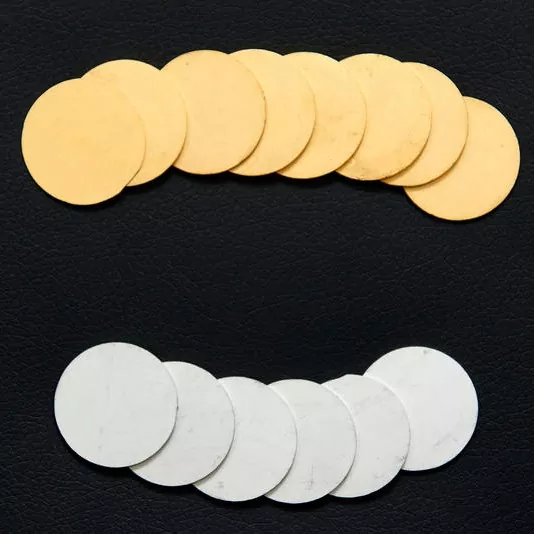
Thin slices equipped with a diffusion barrier layer represent a more advanced intermediate product. The barrier layer is applied to improve the interface between the thermoelectric material and subsequent bonding or metallization systems. Without this layer, elevated temperatures during soldering can cause rapid interdiffusion between the semiconductor and contact metals, leading to degraded performance and eventual failure.
Diffusion-barrier slices are particularly well suited to modules that undergo repeated thermal cycling. Applications such as cooling plates, temperature control modules, and sensor temperature regulation all benefit from the enhanced interfacial stability that these slices provide. They also simplify the process window for engineers who intend to apply nickel, copper, or solder-based metallization in-house.
| Material Form | Primary Advantage | Typical Use Case |
|---|---|---|
| Extruded profiles | High dimensional consistency in large batches | In-house slicing into custom pellet sizes |
| Diffusion-barrier slices | Bond-ready interface with reduced reaction risk | Modules requiring repeated thermal cycling |
| Custom cross-sections | Tailored geometry for specific device designs | Non-standard module architectures |
| Matched P/N sets | Balanced electrical and thermal behavior | Precision temperature control systems |
Selecting the Right Material for Your Application
Material selection begins with two non-negotiable parameters: the expected hot-junction and cold-junction temperatures, and the electrical operating window of the final device. These factors narrow the candidate material systems and define the processing steps that will be required downstream.
Operating Temperature Considerations
Different thermoelectric material systems exhibit peak performance across different temperature ranges. A composition optimized for near-room-temperature cooling may lose efficiency rapidly when the hot side rises above 80°C, while a material designed for moderate temperatures may offer poor performance at sub-zero cold-side conditions. Determining the actual operating temperatures — not simply the target set point — is the first step toward a viable material choice.
Electrical Requirements
Voltage, current, resistance, and power dissipation all interact with material properties. A material with high electrical conductivity reduces Joule heating but may also exhibit higher thermal conductivity, which works against the temperature gradient. The optimal balance depends on the module geometry, the available power supply, and the required cooling capacity. Matching material resistivity to the drive electronics is often as important as maximizing the figure of merit.
Customization Options
Standard material forms do not always satisfy a specific thermal management architecture. When catalog dimensions, compositions, or surface treatments fall short, custom solutions become necessary. Customization can address material dimensions, P-type and N-type matching, composition adjustments, electrical properties, surface or interface treatment, diffusion-barrier requirements, and cutting or machining specifications.
- Material dimensions and cross-sectional geometry
- Matching of P-type and N-type transport properties
- Composition tuning for specific temperature ranges
- Electrical resistivity and Seebeck coefficient targets
- Surface preparation and interface treatment
- Diffusion barrier layer specification
- Cutting, grinding, and machining requirements
Application Landscape Across Industries
The versatility of Thermoelectric Materials has driven adoption across a wide range of industries, from consumer electronics to medical diagnostics and industrial process control. Each application imposes its own constraints on material purity, dimensional tolerance, and interface stability.
Semiconductor Cooling and Precision Temperature Control
Semiconductor cooling remains the largest application area. Laser diodes, optical transceivers, and high-performance processors all benefit from the vibration-free, precise temperature regulation that thermoelectric modules provide. The material quality directly influences wavelength stability, output power consistency, and long-term reliability.
Cooling Plates and Temperature Control Modules
Cooling plates used in analytical instruments, medical devices, and industrial equipment rely on thermoelectric materials to maintain uniform surface temperatures. Temperature control modules for PCR thermocyclers, for example, require rapid heating and cooling rates that depend on low thermal inertia and high electrical conductivity — both of which are material-dependent properties.
Sensor Temperature Regulation
Precision sensors, including infrared detectors and photodiodes, often require stable operating temperatures to maintain calibration and signal-to-noise ratio. Thermoelectric materials enable compact, localized temperature regulation without the bulk and complexity of mechanical refrigeration systems.
Small-Scale Power Generation
When a temperature gradient is applied across a thermoelectric material, the Seebeck effect generates electrical power. This principle supports small-scale energy harvesting in remote sensors, waste-heat recovery systems, and portable power sources. The same material properties that govern cooling performance also determine power generation efficiency, making material selection equally critical in both modes.
Why Material and Device Integration Matters
Material specifications alone do not guarantee a successful thermal solution. The interaction between the material, the metallization system, the solder joints, and the ceramic substrate determines whether the finished module meets its performance targets over thousands of operating hours.
Precision Production Capabilities
Producing thermoelectric modules that deliver consistent performance requires automated processes for printing, reflow soldering, tin dipping, dispensing, sealing, cutting, and solidification. Each step influences the final interface quality and the internal stress state of the semiconductor pellets. Material suppliers who also manufacture modules can evaluate their materials under realistic assembly conditions, closing the feedback loop between material development and device performance.
Application-Based Technical Support
Catalog specifications provide a starting point, but real-world operating conditions — including cooling load, ambient temperature, mounting pressure, and drive electronics — often shift the optimal material choice. Suppliers who consider these factors when recommending a material solution help engineers avoid costly redesigns and field failures.
X-Meritan integrates material development with component manufacturing, allowing material performance to be evaluated in relation to the final thermoelectric application. This integrated approach supports both standard material supply and customized solutions based on drawings, prototypes, or application specifications.
Frequently Asked Questions
How do thermoelectric materials work?
Thermoelectric materials use the Peltier effect to create a temperature difference when an electric current passes through P-type and N-type semiconductor elements. Their electrical and thermal transport properties directly affect the cooling capacity, temperature stability, response speed, and power consumption of the final thermoelectric device.
What is the difference between P-type and N-type thermoelectric materials?
P-type and N-type thermoelectric materials have different charge carrier characteristics and are typically used in combination to form thermoelectric circuits. Their properties must be matched based on the required voltage, current, temperature range, and thermoelectric cooler design. Balanced pairing ensures stable performance and minimizes localized heating.
Do you offer customization services for thermoelectric materials?
Yes. Custom sizes can be evaluated based on drawings, prototypes, or application specifications. Customization options include cross-section, length, thickness, cutting requirements, material composition, electrical properties, surface treatment, and diffusion-barrier layer specifications, depending on the intended thermoelectric component design.
Why are diffusion barriers important in thermoelectric slices?
Diffusion barriers improve the interface between the thermoelectric material and the bonding or metallization system. Without a barrier layer, elevated temperatures during soldering can cause rapid interdiffusion between the semiconductor and contact metals, leading to degraded performance and eventual failure. Barrier layers are especially important in modules that undergo repeated thermal cycling.
Can thermoelectric materials be used for power generation?
Yes. When a temperature gradient is applied across a thermoelectric material, the Seebeck effect generates electrical power. This principle supports small-scale energy harvesting in remote sensors, waste-heat recovery systems, and portable power sources. The same material properties that govern cooling performance also determine power generation efficiency.
What factors determine the lifespan of a thermoelectric material?
Thermal cycling amplitude, maximum operating temperature, interface quality, and the presence of moisture or corrosive gases all influence material lifespan. Consistent batch quality, matched P/N properties, and stable diffusion barriers reduce the risk of premature degradation. Operating the module at lower current fractions and maintaining stable thermal interfaces also extends service life.
From extruded profiles for high-volume slicing to diffusion-barrier slices for advanced module assembly, the right material foundation determines whether a thermal design achieves stable, long-term performance. Whether the requirement calls for near-room-temperature cooling, precision sensor regulation, or small-scale power generation, material selection deserves the same engineering rigor as module architecture.
Contact Us to Discuss Your Thermoelectric Material Requirements