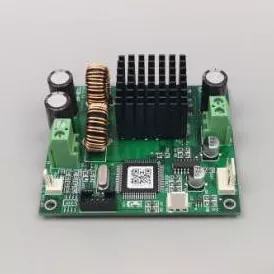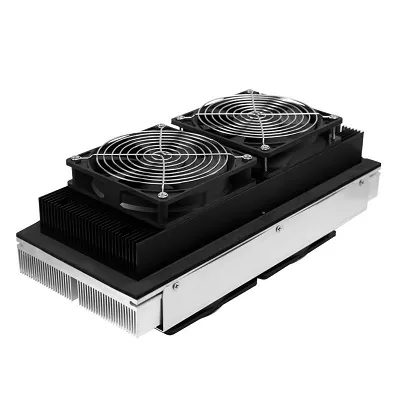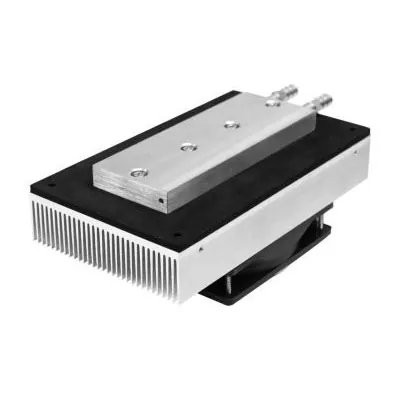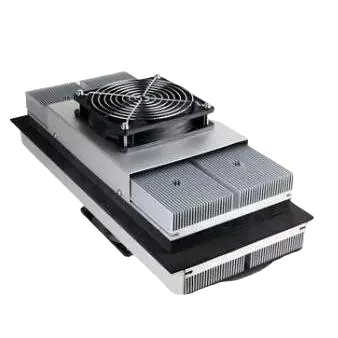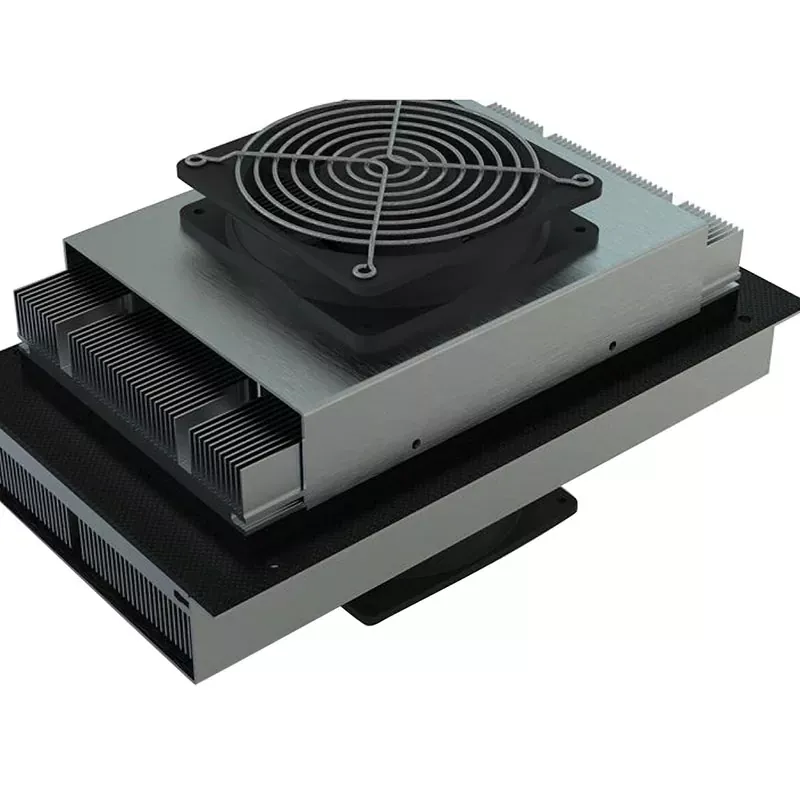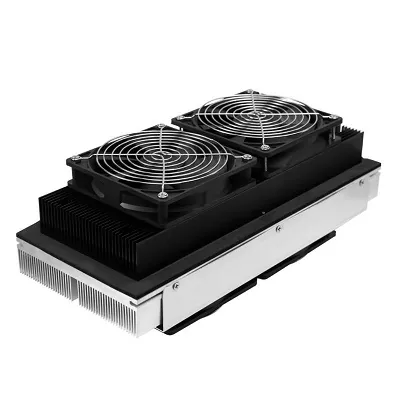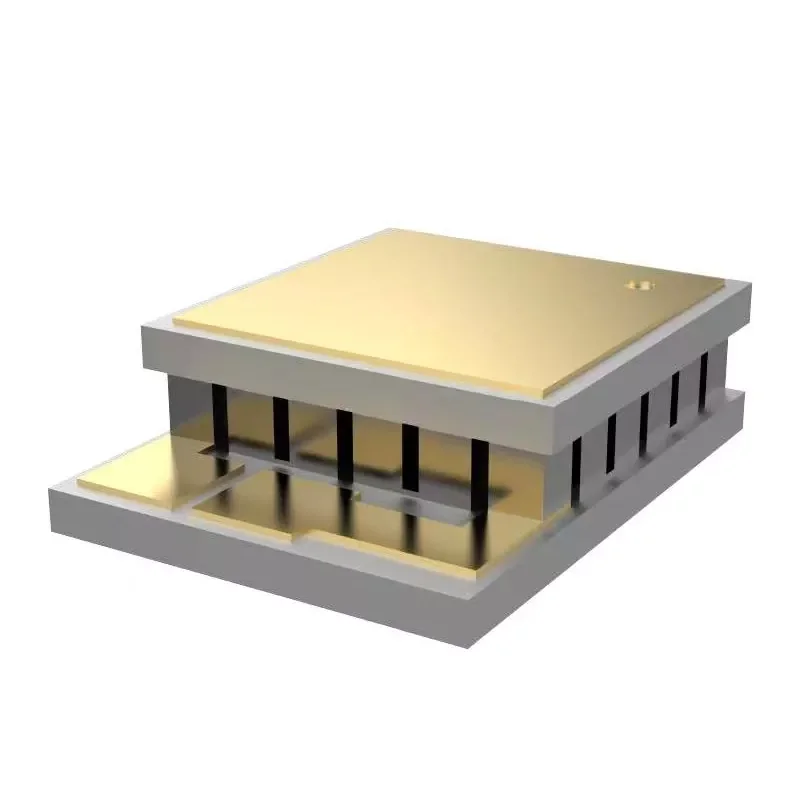
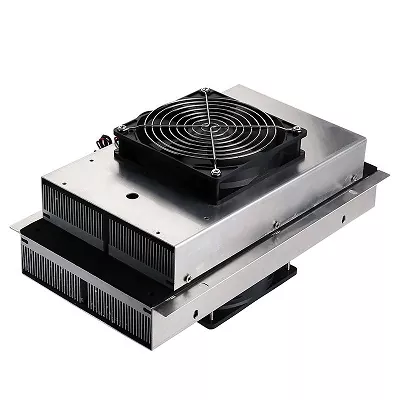
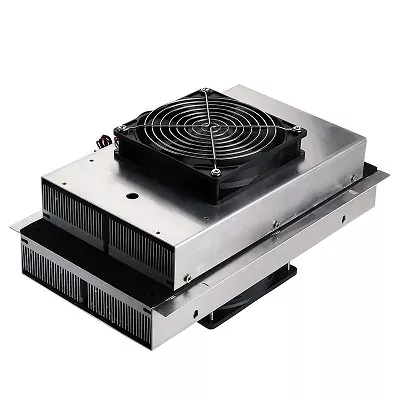
Liquid-to-Liquid Thermoelectric Cooler Assemblies utilize the Peltier effect of the TEC (Thermoelectric Cooler), exchanging heat with the cold and hot ends of the TEC through two independent liquid loops, achieving active cooling or heating of the liquid medium.
If you need such components, please feel free to contact X-Meritan; we will provide you with customized solution design and technical support services.
1. Thermoelectric Cooling Chip (TEC Module): The core thermoelectric conversion element. When direct current is applied, heat is absorbed on one side and released on the other.
2. Cold-Side Liquid Block: The target circulating liquid flows through this area, transferring heat to the cold side of the TEC, thus cooling the liquid.
3. Hot-Side Liquid Block: Cooling water or coolant flows through this area, carrying away heat generated by the hot side of the TEC, thus dissipating system heat.
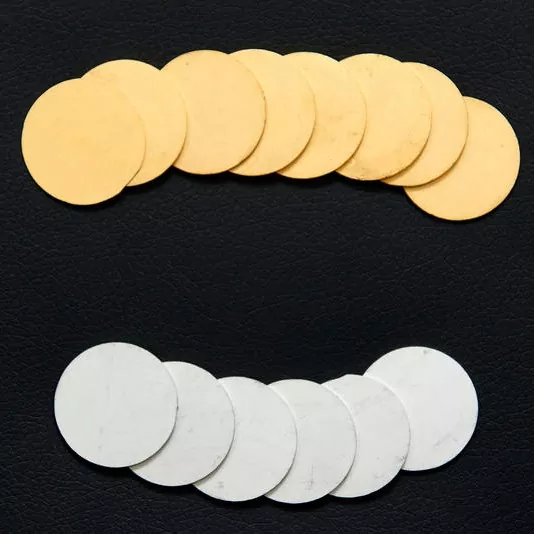
4. Thermal Conducting Medium and Sealing Structure: Ensures efficient heat conduction and prevents liquid leakage.
Workflow: Target Liquid → Flows through the cold-side liquid block → Heat is absorbed by the TEC → Transferred to the hot-side liquid block → Cooling water carries away the heat.
The thermal conductivity of liquids is much higher than that of air: water's thermal conductivity is more than 20 times that of air, and its specific heat capacity is 4 times that of air.
High heat transfer convection coefficient: When liquid flows through the liquid cooler, it achieves very high heat transfer efficiency, ensuring low thermal resistance on both the hot and cold sides of the TEC, achieving high-power heat transfer within a small volume.
Uniform fluid heat transfer: The liquid medium can closely adhere to the microchannels inside the liquid cooler, eliminating localized hot spots.
Temperature stability: With a PID drive circuit and a high-precision temperature sensor, the liquid-to-liquid system can stabilize the outlet temperature of the circulating liquid within ±0.01~0.1°C.
Environmental isolation: The Liquid-to-Liquid system can conduct heat through water pipes to the main water-cooled circulation system in an adjacent room or outdoors for exhaust, achieving zero airflow disturbance and zero secondary dust pollution. Vibration-free and low-noise: The components themselves have no moving mechanical parts such as fans, eliminating the possibility of mechanical micro-vibrations.
The Liquid to Liquid system can forcibly reduce the TEC hot-face temperature by connecting to an external, lower-temperature factory cooling water network, thereby maintaining a large operating temperature difference.
|
Comparison Projects |
Liquid to Liquid |
Traditional Air-Cooled TEC |
|
Heat Exchange Medium |
Liquid |
Air |
|
Continuous Heat Dissipation |
More suitable |
Depends on the air-cooling system |
|
System Space |
The heat dissipation components can be moved to a more remote location |
Radiators are usually located near the TEC |
|
Fan Dependence |
This can reduce reliance on local fans |
Fan assistance required |
|
Liquid Temperature Control |
Directly suitable |
Additional heat exchange structure required |
|
System Integration |
Equipment suitable for existing fluid circuits |
Suitable for general electronic heat dissipation |
|
Typical Applications |
Laser, medical, optical communication, experimental equipment |
Small electronic and consumer devices |
|
Parameter Item |
Technical Specification |
|
Maximum Cooling Capacity (Qc Max) |
50W ~ 1500W |
|
Operating Voltage (Vmax) |
12V, 24V, 48V DC |
|
Operating Current (Imax) |
2A ~ 30A |
|
Hot/Cold End Interface Type |
G1/8", G1/4", NPT |
|
Recommended Coolants |
Deionized water, Ethylene glycol water solution |
Liquid-to-Liquid Thermoelectric Cooler Assemblies are used in industrial, medical, and scientific research fields where high temperature stability and heat exchange efficiency are required:
● Medical and Bioanalytical: Precise liquid temperature control in blood analyzers, PCR gene amplification instruments, and dialysis equipment.
● Semiconductor and Laser Equipment: Temperature control of local liquid cooling circuits in high-power semiconductor lasers and lithography machines.
● Industrial Analytical Instruments: Reagent and sample cooling systems in chromatographs and mass spectrometers.
● New Energy and Laboratories: Battery thermal management testing and temperature-controlled liquid circulation in precision chemical reaction processes.
X-Meritan will accurately calculate heat absorption, operating temperature difference, and voltage and current constraints based on the customer's application environment.
We then provide overall thermal management system design suggestions, including air cooling, liquid cooling, and heat pipe conduction.
We support customized structural and electrical parameters based on customer-provided CAD drawings or physical samples. We offer optional services such as different ceramic substrate materials, irregular structures, special leads, and moisture-proof sealing.
After solution confirmation, before mass production, we will send high-precision samples and guide customers in optimizing cold/hot surface contact thermal resistance, controlling installation pressure, and tuning PWM drive signals.
Utilizing our factory's fully automated pick-and-place machines, curing machines, reflow soldering machines, tin-dip furnaces, and sealing machines, we ensure batch consistency.
If products fail to meet standards due to production quality issues, X-Meritan promises to provide full compensation and replacement services.
A: Yes. The liquid flow rate affects the heat exchange capacity on both the cold and hot sides.
If the flow rate is too low, heat may not be removed in time; if the flow rate is too high, pump pressure and system energy consumption must be considered simultaneously.
Therefore, flow rate, inlet temperature, outlet temperature, and heat load should be evaluated as a whole when selecting a model.
A: Using untreated tap water may lead to scaling or biofouling inside the microchannels. It is recommended to use deionized water or a circulating fluid with an appropriate amount of corrosion and mildew inhibitor.
If a decrease in heat exchange efficiency occurs, the water circuit can be regularly flushed and maintained with a weakly acidic cleaning solution.
A: Deionized water or an aqueous ethylene glycol solution is recommended. Important notes:
1. Avoid mixing different metals: Mixing different metals in a liquid cooling circuit may cause electrochemical corrosion.
2. Prevent liquid leaks: Most coolants are conductive; always disconnect the power supply when adding or draining coolant.
3. Cold end insulation: Cold end heat exchangers require insulation to reduce the risk of condensation.
Address
Building C2, R&F Center, Shangpu Road, Taijiang District, Fuzhou City, Fujian Province, China
Tel
Ready to start your next thermal management project or request a competitive price quote? The X-meritan engineering and sales team is standing by to analyze your project requirements, recommend suitable standard TEC models, or discuss fully custom thermoelectric cooler manufacturing options.
Simply fill out the inquiry form with your operating parameters—such as heat load, ambient temperature, target cold-side temperature, dimensions, and estimated annual volume. Our technical sales engineers will review your thermal constraints and respond with a detailed quotation and engineering assessment within 24 business hours.